Myths, folklore, and symbolism
Apple: By tradition, but not by scriptural authority, the fruit of the Tree of Knowledge, perhaps a borrowing by early Christian artists from the classical image of the golden apple tree of the Hesperides; hence a symbol of the Fall of Man and, when held by the infant Christ, an allusion to his future mission as Redeemer. An apple in the mouth of an ape has a similar meaning. Golden apples are the attribute of vigilance personified, and of the harpies that accompany avarice. They are picked up by a maiden overtaken by a running youth (Atalanta and Hippomenes). A golden apple was thrown down into the banquet of the gods, and was later awarded by Paris to Venus. The apple is an attribute of Venus. Apples are the attribute of the three graces, handmaidens of Venus, and, with roses in the basket, of Dorothea. (Dictionary of Subjects & Symbols in Art)
Friday, August 29, 2008


Thursday, August 28, 2008
Linky links!
Yay, one of my favorite artists, Catrina Horsfield, now has a blog! Check it out!
Heather Domin's got her latest In Hortum up, an entertaining (as always) look at the goodies in a Roman garden. This time around: valerian and yarrow.
Made of pure, grade-A awesome: learn Old English with the Unlocked Wordhoard!
Heather Domin's got her latest In Hortum up, an entertaining (as always) look at the goodies in a Roman garden. This time around: valerian and yarrow.
Made of pure, grade-A awesome: learn Old English with the Unlocked Wordhoard!
Myths, folklore & symbolism

"The eightpointed star is a very old symbol for 41a07, the planet Venus..."
Get the full story at symbols.com.
"The eightpointed star is a very old symbol for 41a07, the planet Venus..."
Get the full story at symbols.com.
Wednesday, August 27, 2008
Fairy Rings
Myths, folklore, and symbolism
Fairy Rings: Circle dancing (carol) was the norm in medieval society, but later English dances were so different that dancing in a ring came to seem not merely old-fashioned or childish but uncanny, associated with fairies or witches. When circles of lush, dark, green grass were seen in meadows, they were said to mark the place where fairies had danced, and anybody who set foot in one risked being carried off. Such rings are caused by underground fungi, which at times produce visible toadstools; they persist for years, getting steadily larger, and grazing animals avoid them. No serious belief now attaches to them; at most, a vague idea that it is unlucky to step into one, or, contrariwise, that one can make a wish. (Oxford Dictionary of English Folklore)
Do you know of fairy ring folklore from other countries?
Fairy Rings: Circle dancing (carol) was the norm in medieval society, but later English dances were so different that dancing in a ring came to seem not merely old-fashioned or childish but uncanny, associated with fairies or witches. When circles of lush, dark, green grass were seen in meadows, they were said to mark the place where fairies had danced, and anybody who set foot in one risked being carried off. Such rings are caused by underground fungi, which at times produce visible toadstools; they persist for years, getting steadily larger, and grazing animals avoid them. No serious belief now attaches to them; at most, a vague idea that it is unlucky to step into one, or, contrariwise, that one can make a wish. (Oxford Dictionary of English Folklore)
Do you know of fairy ring folklore from other countries?
Tuesday, August 26, 2008
Author Interview: Jeff Sypeck
My interview with Jeff Sypeck, author of Becoming Charlemagne, is now live over at the Writers and Soundtracks blog. Check it out!
Monday, August 25, 2008
Historical Novels Review: SEEKERS OF THE CHALICE
Now that the August issue of Historical Novels Review is live, I can post this review which appears in that issue.
SEEKERS OF THE CHALICE
Brian Cullen, Tor, $25.95, hb, 368pp, 978-0-7653-1473-4
In ancient Ireland, in a time when gods and men walked the earth along with demons, the Chalice of Fire, the symbol of peace for Ulster, is stolen from the Red Branch. A small band of Seekers set out to recover and return the Chalice to the Red Branch to bring peace once again to the Ulster Kingdom.
Loosely based on the Táin Bó Cúailnge, or the Cattle Raid of Cooley, the concept is interesting – take the forms and structures of traditional high fantasy and apply them to Celtic mythology. Unfortunately, the execution does not meet those expectations. The characters are flat, stock characters without any depth. The action is meandering, a series of nearly identical disconnected fight scenes with a different enemy (vampires! Werewolves! Hags!) The Dreamworld/Otherworld/Earthworld concept was interesting, but never felt fleshed out.
The most frustrating and distracting issue with the book was the indifferent editing, including serious continuity errors toward the end of the story which made me shake my head and put the book down. It is an easy read overall, but for me, not a satisfying one.
The concept was interesting and I really wanted to like this book more than I did. I hope the planned second and third books in this trilogy continue the story and concept with more heart, more depth, and more polish.
SEEKERS OF THE CHALICE
Brian Cullen, Tor, $25.95, hb, 368pp, 978-0-7653-1473-4
In ancient Ireland, in a time when gods and men walked the earth along with demons, the Chalice of Fire, the symbol of peace for Ulster, is stolen from the Red Branch. A small band of Seekers set out to recover and return the Chalice to the Red Branch to bring peace once again to the Ulster Kingdom.
Loosely based on the Táin Bó Cúailnge, or the Cattle Raid of Cooley, the concept is interesting – take the forms and structures of traditional high fantasy and apply them to Celtic mythology. Unfortunately, the execution does not meet those expectations. The characters are flat, stock characters without any depth. The action is meandering, a series of nearly identical disconnected fight scenes with a different enemy (vampires! Werewolves! Hags!) The Dreamworld/Otherworld/Earthworld concept was interesting, but never felt fleshed out.
The most frustrating and distracting issue with the book was the indifferent editing, including serious continuity errors toward the end of the story which made me shake my head and put the book down. It is an easy read overall, but for me, not a satisfying one.
The concept was interesting and I really wanted to like this book more than I did. I hope the planned second and third books in this trilogy continue the story and concept with more heart, more depth, and more polish.
The Word Hoard: panoptic, earthgrine, firk
This week's word-hoard feature: panoptic, earthgrine, and firk.
I invite you to listen in and leave me a comment with your creative use of each week's word-hoard featured words! You can subscribe to this podcast (and this whole blog for that matter) by clicking on the RSS icon in the right-sidebar. Or, you can add the feed to your LiveJournal Friends page.
1. Search for "Julie K. Rose" or "Word-Hoard" in the iTunes store; the podcast will show up in the search results, and you can simply click the "subscribe button"; or
2. Choose the Advanced menu, and then Subscribe to Podcast. This will bring up a dialog box, where you can paste this URL: http://feeds.feedburner.com/blogspot/YULh.
I invite you to listen in and leave me a comment with your creative use of each week's word-hoard featured words! You can subscribe to this podcast (and this whole blog for that matter) by clicking on the RSS icon in the right-sidebar. Or, you can add the feed to your LiveJournal Friends page.
1. Search for "Julie K. Rose" or "Word-Hoard" in the iTunes store; the podcast will show up in the search results, and you can simply click the "subscribe button"; or
2. Choose the Advanced menu, and then Subscribe to Podcast. This will bring up a dialog box, where you can paste this URL: http://feeds.feedburner.com/blogspot/YULh.
Friday, August 22, 2008
Blindness
Myths, folklore & symbolism
Blindness: Blind old men often symbolize wisdom, the inner light, the visionary view; thus seers (e.g., Tiresias) are often blind. At the same time, blindness (even in seers) can be divine punishment for having seen something divinely forbidden. In the Bible, blindness and madness are punishments for disobedience to God. Christ's healings of the blind are sometimes understood to be acts that symbolize illumination in spiritual darkness; thus they can also represent illumination through baptism. (Herder)
Blindness: Blind old men often symbolize wisdom, the inner light, the visionary view; thus seers (e.g., Tiresias) are often blind. At the same time, blindness (even in seers) can be divine punishment for having seen something divinely forbidden. In the Bible, blindness and madness are punishments for disobedience to God. Christ's healings of the blind are sometimes understood to be acts that symbolize illumination in spiritual darkness; thus they can also represent illumination through baptism. (Herder)
Thursday, August 21, 2008
Myths, folklore & symbolism

"An alchemic sign for tartar, tartrate, i.e. tartaric acid salts..."
Get the full story at symbols.com.
"An alchemic sign for tartar, tartrate, i.e. tartaric acid salts..."
Get the full story at symbols.com.
Wednesday, August 20, 2008
Atman
Myths, folklore, and symbolism
Atman In Hinduism, it is the innermost essence of each individual or the supreme universal self (from Sanskrit atman, breath, soul). (Herder)
Atman In Hinduism, it is the innermost essence of each individual or the supreme universal self (from Sanskrit atman, breath, soul). (Herder)
Tuesday, August 19, 2008
Author Soundtrack: Jeff Sypeck
Jeff Sypeck's soundtrack is now live over at the Writers and Soundtracks blog. Check it out!
Monday, August 18, 2008
The Word Hoard: poculent, neezled, vinolency
This week's word-hoard feature: poculent, neezled, and vinolency.
I invite you to listen in and leave me a comment with your creative use of each week's word-hoard featured words! You can subscribe to this podcast (and this whole blog for that matter) by clicking on the RSS icon in the right-sidebar. Or, you can add the feed to your LiveJournal Friends page.
1. Search for "Julie K. Rose" or "Word-Hoard" in the iTunes store; the podcast will show up in the search results, and you can simply click the "subscribe button"; or
2. Choose the Advanced menu, and then Subscribe to Podcast. This will bring up a dialog box, where you can paste this URL: http://feeds.feedburner.com/blogspot/YULh.
I invite you to listen in and leave me a comment with your creative use of each week's word-hoard featured words! You can subscribe to this podcast (and this whole blog for that matter) by clicking on the RSS icon in the right-sidebar. Or, you can add the feed to your LiveJournal Friends page.
1. Search for "Julie K. Rose" or "Word-Hoard" in the iTunes store; the podcast will show up in the search results, and you can simply click the "subscribe button"; or
2. Choose the Advanced menu, and then Subscribe to Podcast. This will bring up a dialog box, where you can paste this URL: http://feeds.feedburner.com/blogspot/YULh.
Friday, August 15, 2008
Linky links
Issue #11 of Serendipity is now live with some interesting new stories - "Camber" by Lena Patton is particularly fun.
Looking forward to getting my hands on this, just released today:
Looking forward to getting my hands on this, just released today:
Two Cranes Press presents A Field Guide to Surreal Botany, an anthology of fictional plant species that exist beyond the realm of the real, with contributions from Jay Lake, Eric Schaller, Darja Malcolm-Clarke, Ben Peek, Victoria Elisabeth Garcia, Mark Teppo, Vera Nazarian, and many, many others. Fully illustrated in gorgeous full-color by Janet Chui, the specimen entries are by turns witty, hilarious, and very strange.
Mermen
Myths, folklore & symbolism
Mermen: Far rarer than mermaids in English tradition, but the Suffolk chronicler Ralph of Coggeshall, about c.1210, tells how some fishermen netted a naked, bearded, hairy-chested "wild man" who looked human "in all his parts" - i.e., he had no tail. He could not speak; he ate most things, but liked raw fish best. He escaped into the sea once, but returned of his own accord; later he escaped again, this time for good. Ralph comments: "Whether he was a mortal man, or a kind of fish bearing a resemblance to humanity, or an evil spirit lurking in the body of a drowned man...it is difficult to decide." (Oxford Dictionary of English Folklore)
What kinds of merman traditions and legends do you know of?
Mermen: Far rarer than mermaids in English tradition, but the Suffolk chronicler Ralph of Coggeshall, about c.1210, tells how some fishermen netted a naked, bearded, hairy-chested "wild man" who looked human "in all his parts" - i.e., he had no tail. He could not speak; he ate most things, but liked raw fish best. He escaped into the sea once, but returned of his own accord; later he escaped again, this time for good. Ralph comments: "Whether he was a mortal man, or a kind of fish bearing a resemblance to humanity, or an evil spirit lurking in the body of a drowned man...it is difficult to decide." (Oxford Dictionary of English Folklore)
What kinds of merman traditions and legends do you know of?
Thursday, August 14, 2008
Myths, folklore & symbolism

"This is one of several signs used to symbolize the art of esoteric alchemy."
Get the full story at symbols.com.
"This is one of several signs used to symbolize the art of esoteric alchemy."
Get the full story at symbols.com.
Wednesday, August 13, 2008
Angelica
Myths, folklore & symbolism
Angelica: It is a plant of the northern hemisphere, and one of the oldest symbolic plants in Christianity. It is a symbol of the Trinity and the Holy Ghost because the stem grows out of two skins that enclose it on either side. It was considered to be the main remedy for pestilence; according to legend, an angel brought the plant to a monk. (Herder)
Angelica: It is a plant of the northern hemisphere, and one of the oldest symbolic plants in Christianity. It is a symbol of the Trinity and the Holy Ghost because the stem grows out of two skins that enclose it on either side. It was considered to be the main remedy for pestilence; according to legend, an angel brought the plant to a monk. (Herder)
Tuesday, August 12, 2008
Author Interview: Hal Duncan
My interview with Hal Duncan is now live over at the Writers and Soundtracks blog. Check it out!
Monday, August 11, 2008
The Word Hoard: metrophobia, romaunt, anagnorisis
This week's word-hoard feature: metrophobia, romaunt, and anagnorisis.
I invite you to listen in and leave me a comment with your creative use of each week's word-hoard featured words! You can subscribe to this podcast (and this whole blog for that matter) by clicking on the RSS icon in the right-sidebar. Or, you can add the feed to your LiveJournal Friends page.
If you'd like to subscribe to the podcast via iTunes, you can do it one of two ways:
1. Search for "Julie K. Rose" or "Word-Hoard" in the iTunes store; the podcast will show up in the search results, and you can simply click the "subscribe button"; or
2. Choose the Advanced menu, and then Subscribe to Podcast. This will bring up a dialog box, where you can paste this URL: http://feeds.feedburner.com/blogspot/YULh.
I invite you to listen in and leave me a comment with your creative use of each week's word-hoard featured words! You can subscribe to this podcast (and this whole blog for that matter) by clicking on the RSS icon in the right-sidebar. Or, you can add the feed to your LiveJournal Friends page.
If you'd like to subscribe to the podcast via iTunes, you can do it one of two ways:
1. Search for "Julie K. Rose" or "Word-Hoard" in the iTunes store; the podcast will show up in the search results, and you can simply click the "subscribe button"; or
2. Choose the Advanced menu, and then Subscribe to Podcast. This will bring up a dialog box, where you can paste this URL: http://feeds.feedburner.com/blogspot/YULh.
Friday, August 08, 2008
Shoes
Myths, folklore & symbolism
Shoes: The popular custom of tying an old shoe to the back of the car in which a bride and groom are setting off for their honeymoon is a specialized form of what was once a widespread practice, that of throwing an old shoe at or after someone to wish them luck, especially on a journey.
Another practice, generally interpreted as defensive magic, was more secretive. As Ralph Merrifield writes:
The only first-hand explanation recorded is this comment from Lincolnshire: "In the old days, a lot of kids died young, so to keep part of the kid with them, or the spirit of the kid if you like, a shoe was buried in the wall of the house so the kid was still with them." ... Explanations as to why shoes should be considered protective can only be conjectural; the two main ones are that they are dirty, especially when they are old...and that they symbolize the female sexual organ. Small model boots or shoes in various materials were used as mantlepiece ornaments "for luck", or as "lucky charms" in jewelry. (Oxford Dictionary of English Folklore)
Shoes: The popular custom of tying an old shoe to the back of the car in which a bride and groom are setting off for their honeymoon is a specialized form of what was once a widespread practice, that of throwing an old shoe at or after someone to wish them luck, especially on a journey.
Another practice, generally interpreted as defensive magic, was more secretive. As Ralph Merrifield writes:
There are few local museums in southern England that do not possess a few shoes, mostly dating from the 17th to the 19th century, that were found hidden in old houses, usually in a wall, roof, or chimney breast, or under a floor...deposited in places that are normally accessible only at the time of building or structural alteration, or by taking considerable trouble at other times, for example by raising a floorboard.
The only first-hand explanation recorded is this comment from Lincolnshire: "In the old days, a lot of kids died young, so to keep part of the kid with them, or the spirit of the kid if you like, a shoe was buried in the wall of the house so the kid was still with them." ... Explanations as to why shoes should be considered protective can only be conjectural; the two main ones are that they are dirty, especially when they are old...and that they symbolize the female sexual organ. Small model boots or shoes in various materials were used as mantlepiece ornaments "for luck", or as "lucky charms" in jewelry. (Oxford Dictionary of English Folklore)
Thursday, August 07, 2008
Hilarious!
Funny stuff, but don't click if you have problems with profanity. I can't imagine that you do, but just in case :)
Props to my mate Nigel for this one!
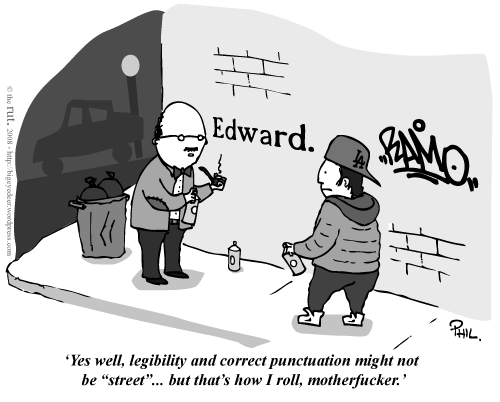
Props to my mate Nigel for this one!
Myths, folklore & symbolism

"A Bronze Age altar from around 1000 B.C., found in Scania, Sweden, has this form. It also appears on Nordic rock carvings, and in many ancient civilizations."
Get the full story at symbols.com.
"A Bronze Age altar from around 1000 B.C., found in Scania, Sweden, has this form. It also appears on Nordic rock carvings, and in many ancient civilizations."
Get the full story at symbols.com.
Wednesday, August 06, 2008
Coral
Myths, folklore, and symbolism
Coral: Coral beads hung round babies' necks were seen by some as purely decorative, and coral teething rings as purely practical; however, others believed coral warded off evil, as Reginald Scot noted in 1584
Some elaborate children's corals of the 18th and 19th centuries, silver mounted and with bells attached, have a tapering and twisting shape reminiscent of Neapolitan phallic horns, famous as charms against the Evil Eye; it may well be that the superstition, like the substance itself, is imported. (Oxford Dictionary of English Folklore)
Do you know of coral folklore from other countries?
Coral: Coral beads hung round babies' necks were seen by some as purely decorative, and coral teething rings as purely practical; however, others believed coral warded off evil, as Reginald Scot noted in 1584
The corrall preserveth such as beare it from fascination or bewitching, and in this respect they are hanged about children's necks. But from whence that superstition is derived, and who invented the lie, I know not: but I see how readie the people are to give credit thereunto, by the multitude of corrals that be employed. (Discoverie of Witchcraft, 1584: book 13, chapter 6).
Some elaborate children's corals of the 18th and 19th centuries, silver mounted and with bells attached, have a tapering and twisting shape reminiscent of Neapolitan phallic horns, famous as charms against the Evil Eye; it may well be that the superstition, like the substance itself, is imported. (Oxford Dictionary of English Folklore)
Do you know of coral folklore from other countries?
Tuesday, August 05, 2008
In Hortum
The latest In Hortum features lavender and lemon balm. These posts are so interesting, and informative. Check it out!
Monday, August 04, 2008
Author Soundtrack: Hal Duncan
Hal Duncan's soundtrack is now live over at the Writers and Soundtracks blog. Check it out!
The Word Hoard: callifudge, squiddled, and bumwhush
This week's word-hoard feature: callifudge, squiddled, and bumwhush.
I invite you to listen in and leave me a comment with your creative use of each week's word-hoard featured words! You can subscribe to this podcast (and this whole blog for that matter) by clicking on the RSS icon in the right-sidebar. Or, you can add the feed to your LiveJournal Friends page.
If you'd like to subscribe to the podcast via iTunes, you can do it one of two ways:
1. Search for "Julie K. Rose" or "Word-Hoard" in the iTunes store; the podcast will show up in the search results, and you can simply click the "subscribe button"; or
2. Choose the Advanced menu, and then Subscribe to Podcast. This will bring up a dialog box, where you can paste this URL: http://feeds.feedburner.com/blogspot/YULh.
I invite you to listen in and leave me a comment with your creative use of each week's word-hoard featured words! You can subscribe to this podcast (and this whole blog for that matter) by clicking on the RSS icon in the right-sidebar. Or, you can add the feed to your LiveJournal Friends page.
If you'd like to subscribe to the podcast via iTunes, you can do it one of two ways:
1. Search for "Julie K. Rose" or "Word-Hoard" in the iTunes store; the podcast will show up in the search results, and you can simply click the "subscribe button"; or
2. Choose the Advanced menu, and then Subscribe to Podcast. This will bring up a dialog box, where you can paste this URL: http://feeds.feedburner.com/blogspot/YULh.
Friday, August 01, 2008
Witch balls
Myths, folklore & symbolism
Witch balls: Large, heavy glass balls coated with glossy reflecting silver, gold, or brightly colored paint, first made about 1690, and popular in the 19th century; or a smaller type from the late 18th century, with swirling multi-colored patterns. Both were meant to hang in cottage windows; their purpose was to attract and neutralize the evil eye of a passing witch, either by reflecting it back upon her or by puzzling her with the pattern. Plain glass balls filled with bright tangled threads were thought to have the same effect. Alternative names are "wish ball" and "watch ball"; the latter is sometimes explained by saying that the ball grows dull if there is infection "in the air", and so should be watched for a warning. (Oxford Dictionary of English Folklore)
What other traditions/customs do you know of that use physical objects to protect against witches?
Witch balls: Large, heavy glass balls coated with glossy reflecting silver, gold, or brightly colored paint, first made about 1690, and popular in the 19th century; or a smaller type from the late 18th century, with swirling multi-colored patterns. Both were meant to hang in cottage windows; their purpose was to attract and neutralize the evil eye of a passing witch, either by reflecting it back upon her or by puzzling her with the pattern. Plain glass balls filled with bright tangled threads were thought to have the same effect. Alternative names are "wish ball" and "watch ball"; the latter is sometimes explained by saying that the ball grows dull if there is infection "in the air", and so should be watched for a warning. (Oxford Dictionary of English Folklore)
What other traditions/customs do you know of that use physical objects to protect against witches?
Subscribe to:
Posts (Atom)