Myths, folklore & symbolism
lark: As a bird that flies straight up into the sky and builds its nest in the earth, it is symbol of the union of sky and earth. (Herder)
Friday, September 28, 2007


Thursday, September 27, 2007
Here's this week's Booking Through Thursday meme:
Well, the flip answer is that I would just check out their amazon wishlist and see what they want. Or, I'd check out their Library Thing account to see what they've been reading.
Now, to be sentimental, I would probably give them a book of poetry, based on the kind of relationship we have. Some friends would get Billy Collins, others Mary Oliver; one friend might get Daniel Ladinsky's translations of Hafiz, while another might get a collection of Emily Dickinson.
Buy a Friend a Book Week is October 1-7 (as well as the first weeks of January, April, and July). During this week, you’re encouraged to buy a friend a book for no good reason. Not for their birthday, not because it’s a holiday, not to cheer them up–just because it’s a book.
What book would you choose to give to a friend and why?
Well, the flip answer is that I would just check out their amazon wishlist and see what they want. Or, I'd check out their Library Thing account to see what they've been reading.
Now, to be sentimental, I would probably give them a book of poetry, based on the kind of relationship we have. Some friends would get Billy Collins, others Mary Oliver; one friend might get Daniel Ladinsky's translations of Hafiz, while another might get a collection of Emily Dickinson.
Serendipity Magazine is looking for submissions for their free monthly journal of magical realist fiction. I read in their blog that they are getting a lot of submissions from guys, but not nearly enough from women. So, ladies, check out their submissions guidelines and let's do something about that particular imbalance!
If I had something ready to go, I totally would. I can't get sidetracked from finishing Oleanna before NaNo, but this is sure tempting.
If I had something ready to go, I totally would. I can't get sidetracked from finishing Oleanna before NaNo, but this is sure tempting.
Myths, Symbols & Folklore
Midday (Midnight): Like the summer and winter solstices, midday and midnight are temporal turning points that for ages have had special significance. In China they are considered to be the high points, respectively, of yang and yin influences. According to the esoteric view, midnight is the time when the spiritual (in contrast to the physical) sun stands at the zenith; consequently, midnight is associated with contemplation, initiation, and spiritual knowledge and insight. In folk belief midnight is the witching hour when contact with spirits, poor souls, etc. can most easily be established. In fairy tales the midnight hour, and the bright hours of day when no shadows fall, are the times of mysterious happenings. The midday heat of summer was believed in antiquity to be the hour of Pan. (Herder)
Midday (Midnight): Like the summer and winter solstices, midday and midnight are temporal turning points that for ages have had special significance. In China they are considered to be the high points, respectively, of yang and yin influences. According to the esoteric view, midnight is the time when the spiritual (in contrast to the physical) sun stands at the zenith; consequently, midnight is associated with contemplation, initiation, and spiritual knowledge and insight. In folk belief midnight is the witching hour when contact with spirits, poor souls, etc. can most easily be established. In fairy tales the midnight hour, and the bright hours of day when no shadows fall, are the times of mysterious happenings. The midday heat of summer was believed in antiquity to be the hour of Pan. (Herder)
Wednesday, September 26, 2007
First of all, here's an interesting link: Endicott Studios features artist Steven Kenny. You know, I love magical realism/surrealism/fantasy in writing, and in movies, but when I see a surrealist painting? It freaks me the hell out. Seriously. These paintings are really interesting conceptually, and well executed, and they give me the heebie jeebies. Maybe that's the point.
Myths, Symbols & Folklore
sulfur: In alchemy it, like salt and mercury, is one of the philosophical elements and universal principles. It represents the "fiery" element or the energy and the soul (anima) of nature; it was sometimes also compared to the sun. Medieval folk belief associated sulfur with the infernal and saw it, its flames, and the odor as attributes of the Devil. (Herder)
Myths, Symbols & Folklore
sulfur: In alchemy it, like salt and mercury, is one of the philosophical elements and universal principles. It represents the "fiery" element or the energy and the soul (anima) of nature; it was sometimes also compared to the sun. Medieval folk belief associated sulfur with the infernal and saw it, its flames, and the odor as attributes of the Devil. (Herder)
Tuesday, September 25, 2007
Myths, folklore & symbolism
spinning: Frequently associated with supernatural female triads (fates, Moirae, norns) who spin, gather up, and cut the threads of fate. Women's spinning in general has often been associated with the moon, whose three major phases (full moon, first or third quarter, and new moon) suggest the three figures of Hecate (Hecate Triformis) [Graves]. (The weaving of the threads of fate is similarly considered to be the task of supernatural females.) Spinning and distaffs play an important role in the symbolism of fairy tales, where they are likewise associated with fate and death ("Sleeping Beauty") and often with triads (Brothers Grimm, "Of Wicked Flax Spinning"). Through the moon's apparent death and resurrection, the spinning goddesses of fate are associated with the themes of the underworld and rebirth. In Christian iconography the Virgin Mary is often portrayed holding a distaff (e.g., with the archangel Gabriel in depictions of the Annunciation); this is also a reference back to Eve, who was also frequently portrayed spinning. The association of Mary and the lunar crescent is frequent throughout the centuries.
Spinning was thought of as the domain of the goddesses and priestesses in a great variety of contexts. For example, in the ancient Mayan culture of the Yucatan, Ixcel (under the aspect of the goddess Chac-chel) is a moon goddess portrayed with a weaving stool; as Ixanleom, she is also associated with the spider.
In medieval Europe the spindle, a symbol of the contemplative life, is also an attribute of certain female saints (Joan of Arc, portrayed as a shepherdess; St. Margaret; St. Genevieve).
We speak idiomatically of spinning "yarns" and every other product of the imagination; here our association is not only with the spinning of thread but also with the spider's construction of its web. Even in present-day usage, the word "distaff" is used to replace "female": e.g., the "distaff side" of a family. (Biedermann)
spinning: Frequently associated with supernatural female triads (fates, Moirae, norns) who spin, gather up, and cut the threads of fate. Women's spinning in general has often been associated with the moon, whose three major phases (full moon, first or third quarter, and new moon) suggest the three figures of Hecate (Hecate Triformis) [Graves]. (The weaving of the threads of fate is similarly considered to be the task of supernatural females.) Spinning and distaffs play an important role in the symbolism of fairy tales, where they are likewise associated with fate and death ("Sleeping Beauty") and often with triads (Brothers Grimm, "Of Wicked Flax Spinning"). Through the moon's apparent death and resurrection, the spinning goddesses of fate are associated with the themes of the underworld and rebirth. In Christian iconography the Virgin Mary is often portrayed holding a distaff (e.g., with the archangel Gabriel in depictions of the Annunciation); this is also a reference back to Eve, who was also frequently portrayed spinning. The association of Mary and the lunar crescent is frequent throughout the centuries.
Spinning was thought of as the domain of the goddesses and priestesses in a great variety of contexts. For example, in the ancient Mayan culture of the Yucatan, Ixcel (under the aspect of the goddess Chac-chel) is a moon goddess portrayed with a weaving stool; as Ixanleom, she is also associated with the spider.
In medieval Europe the spindle, a symbol of the contemplative life, is also an attribute of certain female saints (Joan of Arc, portrayed as a shepherdess; St. Margaret; St. Genevieve).
We speak idiomatically of spinning "yarns" and every other product of the imagination; here our association is not only with the spinning of thread but also with the spider's construction of its web. Even in present-day usage, the word "distaff" is used to replace "female": e.g., the "distaff side" of a family. (Biedermann)
Monday, September 24, 2007
Word-hoard podcast: putrilage
This week's word-hoard feature: putrilage.
I invite you to listen in and leave me a comment with your creative use of each week's word-hoard featured word! I probably butchered the pronunciation on this one, so if I got it wrong, please let me know what the right pronunciation is!
You can subscribe to this podcast (and this whole blog for that matter) by clicking on the RSS icon in the right-sidebar. Or, if you'd like to subscribe to the podcast via iTunes, you can do it one of two ways:
1. Search for "Julie K. Rose" or "Word-Hoard" in the iTunes store; the podcast will show up in the search results, and you can simply click the "subscribe button"; or
2. Choose the Advanced menu, and then Subscribe to Podcast. This will bring up a dialog box, where you can paste this URL: http://feeds.feedburner.com/blogspot/YULh.
I invite you to listen in and leave me a comment with your creative use of each week's word-hoard featured word! I probably butchered the pronunciation on this one, so if I got it wrong, please let me know what the right pronunciation is!
You can subscribe to this podcast (and this whole blog for that matter) by clicking on the RSS icon in the right-sidebar. Or, if you'd like to subscribe to the podcast via iTunes, you can do it one of two ways:
1. Search for "Julie K. Rose" or "Word-Hoard" in the iTunes store; the podcast will show up in the search results, and you can simply click the "subscribe button"; or
2. Choose the Advanced menu, and then Subscribe to Podcast. This will bring up a dialog box, where you can paste this URL: http://feeds.feedburner.com/blogspot/YULh.
Friday, September 21, 2007
Back from San Diego, and glad to be home. I really like San Diego, but I never actually got to see it - we spent 4 full days inside a hotel in La Jolla, doing that putting-on-a-big-conference thing. Came home to a sick husband, a cat who sprained her tail (don't ask), and a list of chores longer than my arm. So. Today, it's about links, and not, you know, actual content.
How the Little Rabbi Grew is a short over at Strange Horizons, and is weirdly perfect. Definitely worth taking a few minutes to read. The concept is interesting and I love the cadences in it.
Sarah's Reading the Past blog is always interesting. She linked to this amusing site the other day: LOL Fantasy Book Covers. The dred pirate smurfette is a particular favorite.
The Patrick O'Brian Mapping Project is an amazing site. Want to know the exact routes Jack and Stephen took in Post Captain? Want to know exactly where Jack got into trouble on shore? Where Stephen's modest castle in Catalonia can be found? If so, this lovingly detailed site is your crack, I promise.
Finally, SF Scope is a news aggregator for the latest news in the Speculative Fiction world.
Edited to add: Via BoingBoing, The Guardian's feature on writer's rooms is fascinating. Must be nice to have a room entirely dedicated to writing in your house. Hell, it must be nice to have a house.
How the Little Rabbi Grew is a short over at Strange Horizons, and is weirdly perfect. Definitely worth taking a few minutes to read. The concept is interesting and I love the cadences in it.
Sarah's Reading the Past blog is always interesting. She linked to this amusing site the other day: LOL Fantasy Book Covers. The dred pirate smurfette is a particular favorite.
The Patrick O'Brian Mapping Project is an amazing site. Want to know the exact routes Jack and Stephen took in Post Captain? Want to know exactly where Jack got into trouble on shore? Where Stephen's modest castle in Catalonia can be found? If so, this lovingly detailed site is your crack, I promise.
Finally, SF Scope is a news aggregator for the latest news in the Speculative Fiction world.
Edited to add: Via BoingBoing, The Guardian's feature on writer's rooms is fascinating. Must be nice to have a room entirely dedicated to writing in your house. Hell, it must be nice to have a house.
Wednesday, September 19, 2007
Myths, folklore & symbolism
purple: It is a color associated symbolically with red or violet. Genuine purple, derived from the porphura, a shellfish yielding purple dye, was reserved for the clothing of kings and priests due to its costliness; hence it was a symbol of power and honor. Later it was generally regarded, especially among the Romans, as a sign of luxury and prosperity. (Herder)
purple: It is a color associated symbolically with red or violet. Genuine purple, derived from the porphura, a shellfish yielding purple dye, was reserved for the clothing of kings and priests due to its costliness; hence it was a symbol of power and honor. Later it was generally regarded, especially among the Romans, as a sign of luxury and prosperity. (Herder)
Tuesday, September 18, 2007
Myths, folklore & symbolism
rosemary: A spicy small shrub of Mediterranean countries, the Romans often burned it during sacrifices for its fragrance. In folk customs, rosemary was regarded as a protective agent against illnesses and evil spirits, and in this sense it was used particularly at births, weddings, and deaths.
As a hardy, evergreen plant, rosemary is an old symbol of love, fidelity, fertility, and immortality (when associated with the dead); bridal wreaths were often made of rosemary before myrtle was used. (Herder)
rosemary: A spicy small shrub of Mediterranean countries, the Romans often burned it during sacrifices for its fragrance. In folk customs, rosemary was regarded as a protective agent against illnesses and evil spirits, and in this sense it was used particularly at births, weddings, and deaths.
As a hardy, evergreen plant, rosemary is an old symbol of love, fidelity, fertility, and immortality (when associated with the dead); bridal wreaths were often made of rosemary before myrtle was used. (Herder)
Monday, September 17, 2007
Word-hoard podcast: misarchist
This week's word-hoard feature: misarchist.
I invite you to listen in (click on the link, or subscribe via iTunes) and leave me a comment with your creative use of each week's word-hoard featured word!
You can subscribe to this podcast (and this whole blog for that matter) by clicking on the RSS icon in the right-sidebar.
Or, if you'd like to subscribe to the podcast via iTunes, choose the Advanced menu, and then Subscribe to Podcast. This will bring up a dialog box, where you can paste this URL: http://feeds.feedburner.com/blogspot/YULh.
I invite you to listen in (click on the link, or subscribe via iTunes) and leave me a comment with your creative use of each week's word-hoard featured word!
You can subscribe to this podcast (and this whole blog for that matter) by clicking on the RSS icon in the right-sidebar.
Or, if you'd like to subscribe to the podcast via iTunes, choose the Advanced menu, and then Subscribe to Podcast. This will bring up a dialog box, where you can paste this URL: http://feeds.feedburner.com/blogspot/YULh.
Sunday, September 16, 2007
I'm heading off to San Diego for a few days of work madness. The team I'm on is putting on a conference so there will be a lot of running around and talking into radios and hoping to grab a few bites of food while the attendees eat. I've been doing conferences like this for 10 years, so it's old hat, but still nerve-wracking in the lead-up. So, wish me luck!
I'll probably drop in here now and again while I'm gone, for sure to post the Word-Hoard podcast sometime tomorrow.
Myths, folklore & symbolism
ginseng: Because of the humanoid shape of its root, it is considered in China to be endowed, like the mandrake, with life-prolonging powers. Since people ascribed to it the power to strengthen virility, it was associated with the yang principle. (Herder)
I'll probably drop in here now and again while I'm gone, for sure to post the Word-Hoard podcast sometime tomorrow.
Myths, folklore & symbolism
ginseng: Because of the humanoid shape of its root, it is considered in China to be endowed, like the mandrake, with life-prolonging powers. Since people ascribed to it the power to strengthen virility, it was associated with the yang principle. (Herder)
Friday, September 14, 2007
Myths, Symbols & Folklore
dodecahedron: It is a body bounded by 12 flat polygons. Especially significant symbolically is the pentagonal dodecahedron, which is formed of 12 equilateral pentagons; it participates in the symbolism of the number twelve and five. It was thought to be the most perfect of the five uniform, or Platonic, bodies and is consequently a totality symbol. Plato assumed that the cosmos had the form of a dodecahedron. (Herder)
dodecahedron: It is a body bounded by 12 flat polygons. Especially significant symbolically is the pentagonal dodecahedron, which is formed of 12 equilateral pentagons; it participates in the symbolism of the number twelve and five. It was thought to be the most perfect of the five uniform, or Platonic, bodies and is consequently a totality symbol. Plato assumed that the cosmos had the form of a dodecahedron. (Herder)
Thursday, September 13, 2007
This week's Booking Through Thursday meme is a good (bad?) one:
Okay . . . picture this (really) worst-case scenario: It’s cold and raining, your boyfriend/girlfriend has just dumped you, you’ve just been fired, the pile of unpaid bills is sky-high, your beloved pet has recently died, and you think you’re coming down with a cold. All you want to do (other than hiding under the covers) is to curl up with a good book, something warm and comforting that will make you feel better.
What do you read?
Oh dear. Well, a confluence of events rather similar to this happened to me in March 2006 - we had to put my dear cat Vlad down, and then a week later my mom died unexpectedly. During that time, I didn't read much of anything, to be honest. I might have scanned the news here and there, but I was pretty raw and pretty full up with emotion, and couldn't really focus on any drama but my own.
However, after a few weeks passed I was able to read again and the first thing I picked up was the Lord of the Rings trilogy. I only came to the books when the first movie came out (I know, I know - I was all about the "classics" growing up) but once I read them for the first time, they became my security blanket. I can drop into any part of the trilogy and be engrossed, and feel that great sense of aspiring to something bigger and better than yourself. After having read the trilogy so many times now, it's comforting and familiar.
Okay . . . picture this (really) worst-case scenario: It’s cold and raining, your boyfriend/girlfriend has just dumped you, you’ve just been fired, the pile of unpaid bills is sky-high, your beloved pet has recently died, and you think you’re coming down with a cold. All you want to do (other than hiding under the covers) is to curl up with a good book, something warm and comforting that will make you feel better.
What do you read?
Oh dear. Well, a confluence of events rather similar to this happened to me in March 2006 - we had to put my dear cat Vlad down, and then a week later my mom died unexpectedly. During that time, I didn't read much of anything, to be honest. I might have scanned the news here and there, but I was pretty raw and pretty full up with emotion, and couldn't really focus on any drama but my own.
However, after a few weeks passed I was able to read again and the first thing I picked up was the Lord of the Rings trilogy. I only came to the books when the first movie came out (I know, I know - I was all about the "classics" growing up) but once I read them for the first time, they became my security blanket. I can drop into any part of the trilogy and be engrossed, and feel that great sense of aspiring to something bigger and better than yourself. After having read the trilogy so many times now, it's comforting and familiar.
Myths, symbols & folklore
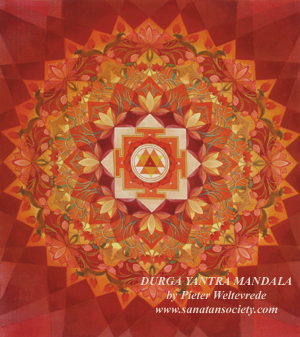
yantra: a graphic aid to meditation, going back to ancient India and still esteemed in the modern era, consisting of geometrically balanced signed, organized symmetrically around a single center. A yantra is usually constructed from successively inscribed triangles, squares, and circles, which are significant to those who are aware of certain conventions but can also communicate directly through the unconscious through archetypal structures of the psyche. The best known is the "Shri" yantra, consisting primarily of artfully arranged triangles, some pointing up and some down in reference to a philosophical duality; they are encircled by rings of lotus leaves within an extended quadratic structure. This yantra is believed to facilitate meditation upon the unity that transcends the polarity of opposites and thus to lead to a feeling of personal empowerment in the face of temporary conflicts. (Biedermann)
yantra: a graphic aid to meditation, going back to ancient India and still esteemed in the modern era, consisting of geometrically balanced signed, organized symmetrically around a single center. A yantra is usually constructed from successively inscribed triangles, squares, and circles, which are significant to those who are aware of certain conventions but can also communicate directly through the unconscious through archetypal structures of the psyche. The best known is the "Shri" yantra, consisting primarily of artfully arranged triangles, some pointing up and some down in reference to a philosophical duality; they are encircled by rings of lotus leaves within an extended quadratic structure. This yantra is believed to facilitate meditation upon the unity that transcends the polarity of opposites and thus to lead to a feeling of personal empowerment in the face of temporary conflicts. (Biedermann)

Wednesday, September 12, 2007
I've hit the midway point in my Oleanna novel (yay for uninterrputed/no Internet time on the train) but I'm frustrated with my progress. I've been working at it since around January and have only now hit halfway. Now, of course, I do have a full time job that sucks up a lot of time and energy, but I think the real issue is that the themes I'm exploring and the situations my characters are in hit very close to home. Is it weird to say that sitting down with the story scares me sometimes?
Myths, Symbols & Folklore
butter: Valued especially in India as the bearer of cosmic energies, it was ritually sacrificed (e.g., poured in the fire). (Herder)
Myths, Symbols & Folklore
butter: Valued especially in India as the bearer of cosmic energies, it was ritually sacrificed (e.g., poured in the fire). (Herder)
Tuesday, September 11, 2007
Myths, symbols & folklore
forest: "Symbologically distinct from the individual tree, the forest stands in many traditions for an exterior world opposed t the microcosm of arable land. In legends and fairy tales the woods are inhabited by mysterious, usually threatening creatures (witches, dragons, giants, dwarfs, lions, bears, and the like) – symbols of all the dangers with which young people must deal if they are to survive their rites of passage and become mature, responsible adults. This image of the forest goes back to a time when great stretches of land were wooded and still had to be cleared for cultivation.
"In dreams the 'dark woods' represent a disoriented phase, the realm of the unconscious, which the conscious person approaches with great hesitation. The light that in fairy tales often filters through the branches, symbolizes the yearning for a place of refuge. The forest itself, nature in the wild, devoid of human order, is felt to be unsettling and dangerous; in our imaginations, it is often peopled with savages and sprites, but also with fairies who can be benevolent. For a contemplative person, on the other hand, the forest can offer some seclusion from the hustle and bustle of the civilized world. Hermit do not fear the dangers of the woods: they are protected by higher powers…For analytic psychologists the forest often symbolizes the feminine as perceived by a young man: a disturbing terrain that he has yet to explore. In a more general sense, we find in the forest 'the green half-light, the alternation of clearing and darkness that parallels the outwardly invisible life of the unconscious'…" (Biedermann)
forest: "Symbologically distinct from the individual tree, the forest stands in many traditions for an exterior world opposed t the microcosm of arable land. In legends and fairy tales the woods are inhabited by mysterious, usually threatening creatures (witches, dragons, giants, dwarfs, lions, bears, and the like) – symbols of all the dangers with which young people must deal if they are to survive their rites of passage and become mature, responsible adults. This image of the forest goes back to a time when great stretches of land were wooded and still had to be cleared for cultivation.
"In dreams the 'dark woods' represent a disoriented phase, the realm of the unconscious, which the conscious person approaches with great hesitation. The light that in fairy tales often filters through the branches, symbolizes the yearning for a place of refuge. The forest itself, nature in the wild, devoid of human order, is felt to be unsettling and dangerous; in our imaginations, it is often peopled with savages and sprites, but also with fairies who can be benevolent. For a contemplative person, on the other hand, the forest can offer some seclusion from the hustle and bustle of the civilized world. Hermit do not fear the dangers of the woods: they are protected by higher powers…For analytic psychologists the forest often symbolizes the feminine as perceived by a young man: a disturbing terrain that he has yet to explore. In a more general sense, we find in the forest 'the green half-light, the alternation of clearing and darkness that parallels the outwardly invisible life of the unconscious'…" (Biedermann)
Monday, September 10, 2007
Word-hoard podcast: mought
Hey everyone - here's the Word-Hoard podcast for this week! Woo hoo!
Listen in (click on the link below, or subscribe via iTunes) and leave me a comment with your creative use of each week's word-hoard featured word!
This week's word-hoard feature: mought.
You can subscribe to this podcast (and this whole blog for that matter) by clicking on the RSS icon in the right-sidebar.
Or, if you'd like to subscribe to the podcast via iTunes, choose the Advanced menu, and then Subscribe to Podcast. This will bring up a dialog box, where you can paste this URL: http://feeds.feedburner.com/blogspot/YULh.
Also, if you're feeling nostalgic, here's last week's word-hoard feature: pitchkettled.
Listen in (click on the link below, or subscribe via iTunes) and leave me a comment with your creative use of each week's word-hoard featured word!
This week's word-hoard feature: mought.
You can subscribe to this podcast (and this whole blog for that matter) by clicking on the RSS icon in the right-sidebar.
Or, if you'd like to subscribe to the podcast via iTunes, choose the Advanced menu, and then Subscribe to Podcast. This will bring up a dialog box, where you can paste this URL: http://feeds.feedburner.com/blogspot/YULh.
Also, if you're feeling nostalgic, here's last week's word-hoard feature: pitchkettled.
Friday, September 07, 2007
Jessica at Bookslut posted this link yesterday, and I just had to share.
http://www.ecolibris.net/
According to the site: "About 20 million trees are being cut down EVERY YEAR to produce the books sold in the U.S. alone."
Their solution? Pay them to plant a tree for every book you read. It's kind of like buying carbon offsets when you travel, but for books. It's a grand idea.
http://www.ecolibris.net/
According to the site: "About 20 million trees are being cut down EVERY YEAR to produce the books sold in the U.S. alone."
Their solution? Pay them to plant a tree for every book you read. It's kind of like buying carbon offsets when you travel, but for books. It's a grand idea.
Myths, Symbols & Folklore
sign of the fig: A symbolic gesture, believed to ward off the evil eye and offer general protection against hostile beings and powers; from the Italian fica ("vulva," "fig").
It consists of making a fist with the thumb protruding between the index and middle fingers, and is interpreted as an "obscene gesture" of contempt, symbolic of sexual intercourse (compare linga and yoni; and the use of the word "fig" in Shakespeare, e.g., in The Second Part of Henry IV, V, 3: "Fig me like the bragging Spaniard"). The belief in its power to ward off evil may go back to the reasoning that spirits are sexless and thus easily frightened by any allusion of a sexual nature (which may also explain the intermingling of genital images, pentacles, and Christian symbols on alpine rock drawings).
In many regions a red coral amulet depicting the sign of the fig is popular even today on watch-chains and necklaces. Medieval depictions of the Passion show hostile bystanders along Christ's route mocking the Savior with the sign of the fig. (Biedermann)
sign of the fig: A symbolic gesture, believed to ward off the evil eye and offer general protection against hostile beings and powers; from the Italian fica ("vulva," "fig").
It consists of making a fist with the thumb protruding between the index and middle fingers, and is interpreted as an "obscene gesture" of contempt, symbolic of sexual intercourse (compare linga and yoni; and the use of the word "fig" in Shakespeare, e.g., in The Second Part of Henry IV, V, 3: "Fig me like the bragging Spaniard"). The belief in its power to ward off evil may go back to the reasoning that spirits are sexless and thus easily frightened by any allusion of a sexual nature (which may also explain the intermingling of genital images, pentacles, and Christian symbols on alpine rock drawings).
In many regions a red coral amulet depicting the sign of the fig is popular even today on watch-chains and necklaces. Medieval depictions of the Passion show hostile bystanders along Christ's route mocking the Savior with the sign of the fig. (Biedermann)
Thursday, September 06, 2007
Myths, Symbols & Folklore
Pandora: The principle figure in a myth contained in Hesiod's Theogony and Works and Days, symbolically attributing all the ills of the world to the female sex. After Prometheus had eased the lot of early man with the gift of fire, the gods decided that human existence was not to become utterly idyllic. The metalsmith and god of fire Hephaestus (Latin Vulcan) crafted a female figure, into which the four winds blew the breath of life. Gods and goddesses lent her beauty. Then the seductive figure was sent among mortals. Although Zeus had made her lazy, ill-natured, and stupid, the naïve Epimetheus, the brother of Prometheus, readily married her. She brought with her a box, or in some versions a jug, out of which emerged all the torments of humanity: age, pain, disease, madness. Only hope, which the box also contained, could keep mortals from immediately ending their lives. "Thus did the pernicious female sex come to be, a great misfortune for the male…She is the mother of the hordes of women who have become the ruin of mortal man." [Hesiod]. "Pandora" ("all-giving") may have been an early epithet of the earth mother Gaea, but this image was subsequently transformed into a profoundly misogynistic myth. According to Hyginus, Pyrrha, Pandora's daughter, was the first mortal woman to be born (i.e., not molded by Hephaestus). In the Greek legend of the Great Flood, she and her husband Deucalion are the two who survive. (Biedermann)
Pandora: The principle figure in a myth contained in Hesiod's Theogony and Works and Days, symbolically attributing all the ills of the world to the female sex. After Prometheus had eased the lot of early man with the gift of fire, the gods decided that human existence was not to become utterly idyllic. The metalsmith and god of fire Hephaestus (Latin Vulcan) crafted a female figure, into which the four winds blew the breath of life. Gods and goddesses lent her beauty. Then the seductive figure was sent among mortals. Although Zeus had made her lazy, ill-natured, and stupid, the naïve Epimetheus, the brother of Prometheus, readily married her. She brought with her a box, or in some versions a jug, out of which emerged all the torments of humanity: age, pain, disease, madness. Only hope, which the box also contained, could keep mortals from immediately ending their lives. "Thus did the pernicious female sex come to be, a great misfortune for the male…She is the mother of the hordes of women who have become the ruin of mortal man." [Hesiod]. "Pandora" ("all-giving") may have been an early epithet of the earth mother Gaea, but this image was subsequently transformed into a profoundly misogynistic myth. According to Hyginus, Pyrrha, Pandora's daughter, was the first mortal woman to be born (i.e., not molded by Hephaestus). In the Greek legend of the Great Flood, she and her husband Deucalion are the two who survive. (Biedermann)
Wednesday, September 05, 2007
Myths, Symbols & Folklore
squirrels: Once viewed with distrust. The squirrel Ratatöskr ("rat-tooth") of Norse mythology constantly ran up and down the world-tree Yggdrasill and sowed strife between the eagle atop it and the dragon Nidnogg, by repeating to each one what the other had just said about it. The squirrel was also associated with the fiery Loki and consequently then in the Christian era with the devil, who seemed to be embodied in the reddish, scurrying, elusive rodent. (Biedermann)
squirrels: Once viewed with distrust. The squirrel Ratatöskr ("rat-tooth") of Norse mythology constantly ran up and down the world-tree Yggdrasill and sowed strife between the eagle atop it and the dragon Nidnogg, by repeating to each one what the other had just said about it. The squirrel was also associated with the fiery Loki and consequently then in the Christian era with the devil, who seemed to be embodied in the reddish, scurrying, elusive rodent. (Biedermann)
Tuesday, September 04, 2007
Myths, Symbols & Folklore
goblet: as a vessel for drink passed from person to person, it is a symbol of friendship and association. In the Bible, it is an ambivalent symbol: as the cup of wrath, it is a sign of God's judgment; as the cup of blessing and joy, it is a symbol of God's presence. (Herder)
goblet: as a vessel for drink passed from person to person, it is a symbol of friendship and association. In the Bible, it is an ambivalent symbol: as the cup of wrath, it is a sign of God's judgment; as the cup of blessing and joy, it is a symbol of God's presence. (Herder)
Saturday, September 01, 2007
I'm very blessed to live in California where we can bop down to our local farmer's market of a Saturday morning and pick up amazing, amazing flowers - for cheap! The ones on my writing desk (AKA the kitchen table) are lisianthus, and the ones on the bookshelf are delphinium. They're so vibrantly blue and ostentatious, I love 'em. The lisianthus are delicate in hue and form and definitely live up to their Victorian reputation for "calming".


Subscribe to:
Posts (Atom)